Is pharmacy inventory a standalone WMS?
No. It is dispense workflow on a Healthcare Operating System—FEFO, billing, queue context, TPA flags, offline replay, and branch transfers on one spine.
Healthcare OS workflow · Pharmacy inventory
Pharmacy inventory is a dispense-stage workflow on Hayati AI Nexus—a Healthcare Operating System—where FEFO batch picks, Schedule H discipline, GST billing, queue-linked patient context, TPA flags, offline counters, and multi-branch transfers share one operational event at the register.
Desktop license—activate on your machine after verified payment. Not a cloud trial signup.
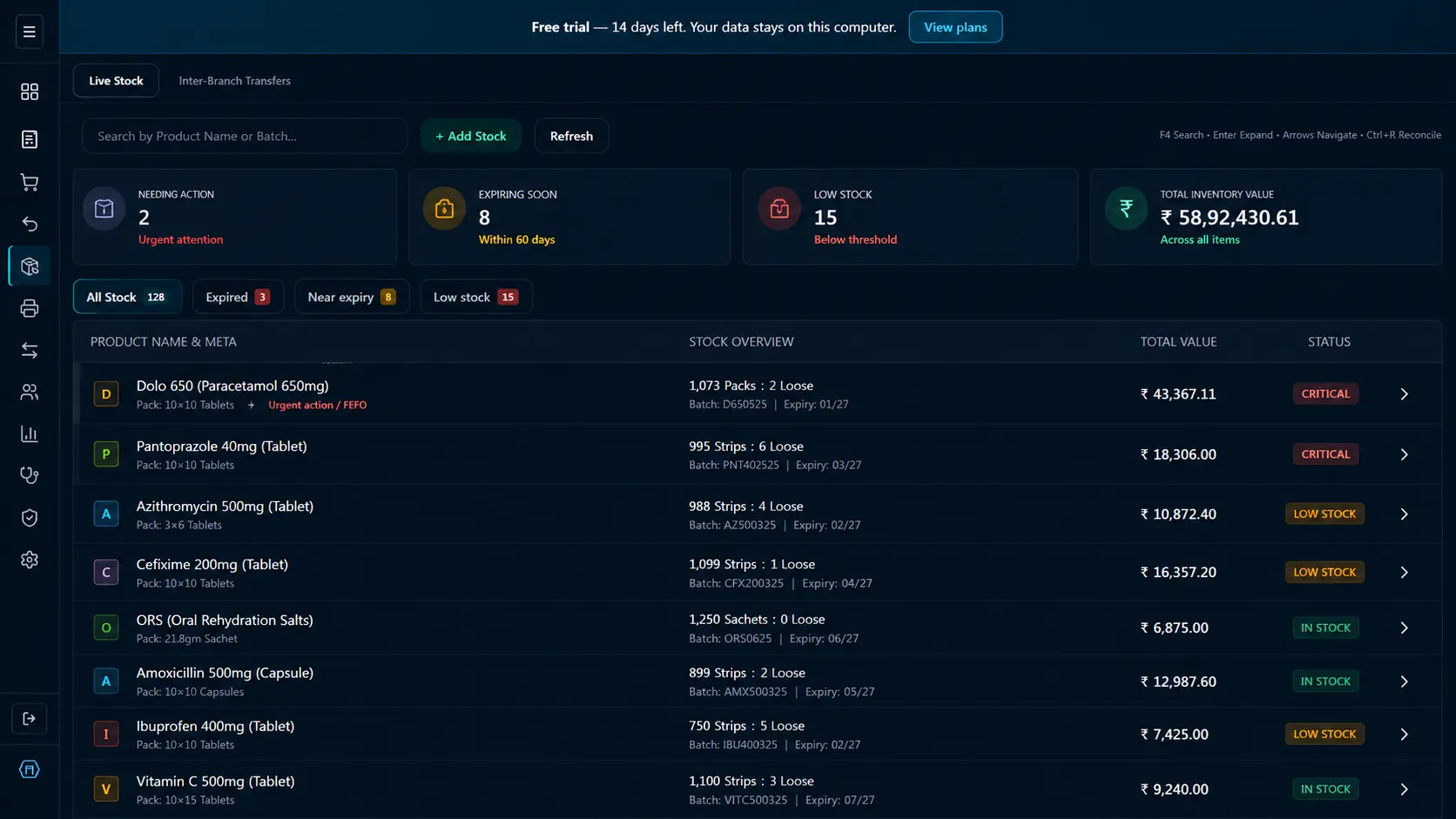
Pharmacy inventory workflow on a Healthcare Operating System is the stock path where purchases become batch-level shelf truth, FEFO selection happens at dispense—not only in monthly reports—Schedule H and H1 prompts match your SOP, stock moves align with GST billing on the same event, barcode labels speed shelf and counter identification, stock journals and dead-stock views surface adjustments and slow movers, supplier outstanding and purchase returns keep purchasing accountable, and branch transfers plus offline replay preserve accountability across hospital dispensaries and retail pharmacy chains. Inventory quality is won or lost at the counter during ordinary hours.
Purchase & batch
Supplier receipt with expiry and rate truth
Shelf & FEFO
Near-expiry visible before write-off
Queue → consult
Patient context from OPD when applicable
Dispense + bill
Batch pick and GST lines together
TPA / returns
Payer and return trace to batch
Branch transfer
Multi-branch stock governance
Indian pharmacies lose margin and compliance in ordinary dispense—not only in dramatic theft. Staff pick the convenient batch during rush hour while older safe stock expires on the shelf. Billing software shows a clean invoice but inventory still counts full quantity. Schedule H medicines dispense without consistent prescription prompts because the counter tool does not know sensitive classification. Hospital pharmacies re-key ward orders into a POS that ignores TPA context from OPD. Multi-branch owners learn about Jaipur near-expiry stock when Mumbai already stockouts—too late for transfer. Returns adjust cash but not batch truth. Standalone inventory modules produce beautiful reports after the write-off is inevitable. The problem is inventory treated as back-office analytics instead of a dispense workflow on a Healthcare Operating System shared with queue, consult, GST billing, offline counters, and TPA alignment. Margin leaks quietly until accounts proves what pharmacists already suspected.
Traditional operators run billing POS plus Excel expiry lists plus WhatsApp transfer requests between branches. Purchases live in supplier notebooks; batch MRP and purchase rate drift from shelf reality. OPD queue and Doctor Dashboard—if they exist—do not constrain which batch gets picked. GST billing may post without stock movement until someone runs a manual adjustment. TPA hospital pharmacies dispense against authorization context in email while the register shows generic cash lines. Offline branches sell from memory when stock masters are stale. AI Receptionist never influences demand planning—it only books appointments disconnected from stock. Finance sees write-offs monthly; pharmacists see the cause daily but lack tools at the counter. Each function maintains partial truth until audit or expiry forces a crisis. Hospital dispensary and retail chain staff learn different workarounds for the same SKU because no single workflow trained them on one spine.
Hayati ties batch, expiry, MRP, purchase rate, and available quantity to the billing path so FEFO is a counter behavior—not a report you read after damage is done. Purchases create batch records finance and pharmacists can reconcile; supplier outstanding views keep payables honest against goods received. Barcode labels support shelf and scan-at-counter identification where hardware is configured. Dispense consumes stock on the same event as GST lines and patient context from queue and Doctor Dashboard when enabled. Schedule H and H1 workflows prompt per your SOP without replacing pharmacist legal responsibility. Stock journals document adjustments with accountability; dead-stock and near-expiry views surface slow movers before write-off becomes inevitable. Purchase returns and customer returns trace to original bill and batch where policy allows. TPA-linked hospital dispensary bills carry payer context inventory disputes must explain. Offline-first counters dispense from locally present masters with replay to multi-branch visibility when sync returns. Transfers between branches record accountability—not verbal agreements. Inventory is a stage on the spine connecting AI intake, queue, consult, Smart Billing, offline replay, TPA review, and HQ stock governance. Walkthroughs should stress everyday rush-hour picks—not only ideal demo SKUs with one batch each.
Pharmacists pick safer batches during rush because expiry is visible at dispense—and barcode labels reduce wrong-SKU keying when scanners are live. Owners surface near-expiry and dead-stock risk weekly instead of discovering write-offs only in accounts. Stock journals give auditors a trail for adjustments instead of WhatsApp folklore. Hospital pharmacies align ward and OPD dispense with billing and TPA context on one record. Retail chains transfer slow movers before expiry becomes loss and track supplier outstanding alongside purchase returns. Finance trusts margin review when purchase rate and billed batch match. Compliance leads audit Schedule H handling with trails—not memory. Multi-branch groups compare shelf truth by facility without calling every store manager. Clinics with small dispensaries connect consult prescriptions to stock without a second keying step. Purchasing teams see which buying patterns create expiry pressure because purchases connect to billing outcomes. Benefits assume purchasing discipline and pharmacist judgment remain human—software makes earlier decisions visible. Hayati does not promise zero expiry loss or automatic compliance certification.
AI Receptionist influences demand indirectly by capturing appointments and repeat visit intent—not by auto-ordering stock without human approval. Queue and Doctor Dashboard hand prescriptions to dispense so inventory sees structured lines instead of handwritten guesses. AI does not select batches silently or override FEFO without pharmacist action where policy requires human confirmation. Retention follow-ups may increase predictable demand patterns branches can review in purchasing—never autonomous PO creation on marketing pages. Measure stockout and near-expiry metrics per branch in pilot—not fabricated ROI percentages. AI plus inventory works when operations connects intake to dispense; otherwise AI is another siloed channel. Pharmacists remain accountable for controlled lines regardless of upstream automation.
Pharmacy inventory consumes and produces context across Hayati AI Nexus modules: AI Receptionist and queue management for patient arrival order; Doctor Dashboard for prescriptions; GST billing and offline billing for register and tax lines on the same dispense event; TPA billing alignment for hospital cashless cases; multi-branch governance for transfers and HQ visibility. Barcode labels, stock journals, dead-stock views, supplier outstanding, and purchase returns sit on the same spine as FEFO. Product and platform pages describe sync; this page describes FEFO and compliance at the counter. Walkthroughs must include multi-batch item, near-expiry batch, barcode path if hardware is live, return, Schedule H line, TPA-linked dispense if applicable, and one offline dispense scenario. Your accountant and lead pharmacist should both see report language they can use—not only IT.
Standalone inventory or WMS tools excel at warehouse scanning and PO workflows. Hayati fits dispensary counters where billing, queue, consult, TPA, GST, and offline continuity happen in one patient journey—not a warehouse miles away. Generic POS may track SKUs without FEFO discipline or payer context. Cloud pharmacy apps may weakly support offline batch picks. Comparison is batch-aware dispense on the patient spine—not the deepest warehouse feature matrix. If you only need back-office stock reports after manual billing, lighter tools may suffice until hospital or chain governance forces integration. Pharmacists should attend walkthroughs—not only procurement—because inventory quality is decided at dispense speed.
Enter supplier receipt with batch, expiry, MRP, and purchase rate so shelf, valuation, and supplier outstanding stay aligned.
OPD path links visit to dispense; Doctor Dashboard prescription flows to counter when enabled.
Counter sees older safe batch before newer stock—pharmacist confirms or overrides per SOP; barcode scan where hardware is configured.
Sensitive lines trigger prompts and review trails—pharmacist retains legal responsibility.
GST billing lines and inventory consumption share one operational event.
Payer context attaches for finance reconciliation before external portal work.
Purchase returns and customer returns link to original bill and batch where rules allow; stock journals document adjustments with accountability.
Inter-branch moves and offline replay preserve batch accountability under multi-branch policy; dead-stock views guide what to move before expiry loss.
No. It is dispense workflow on a Healthcare Operating System—FEFO, billing, queue context, TPA flags, offline replay, and branch transfers on one spine.
First Expiry, First Out—staff should pick the batch expiring soonest when still safe and sellable. Hayati surfaces that at billing, not only in reports.
Yes. Stock consumption and GST invoice lines should describe the same dispense event—returns and audits depend on that alignment.
Barcode labels support shelf and scan-at-counter identification where printers and scanners are configured. Stock journals document quantity adjustments with user trails. Dead-stock and near-expiry views help purchasing and transfer decisions before write-off—validate label formats and report language on walkthrough.
Purchases feed supplier outstanding for payables review; purchase returns trace to supplier and batch where policy allows—alongside customer returns tied to original bills. Confirm your return SOP on walkthrough.
Prompts and trails support controlled dispensing per your SOP. Pharmacist professional responsibility remains with licensed staff.
Batch-aware dispense needs masters present locally before disconnect. Confirm refresh cadence and offline behavior on walkthrough.
Transfers record batch movement with branch accountability on the same spine as billing—validate with real SKUs and near-expiry scenarios.
Payer context on bills helps explain dispense during reconciliation—Hayati aligns internal records; portals remain your process.
Multi-batch item, near-expiry pick, barcode scan if hardware is live, purchase return, customer return, stock journal adjustment, dead-stock view, sensitive medicine line, TPA dispense if applicable, and one offline sale with stock decrement.
Explore Hayati by workflow
GST billing, FEFO inventory, and branch operations for pharmacy counters.
Keep billing locally when internet drops, then sync when the line returns.
Batch, expiry, and stock visibility built into the counter workflow.
Hospital pharmacy billing, branch context, and payer-aligned operations.
Keep pharmacy billing and reconciliation data easier to review.
Governed front-desk support without clinical overclaims.
A factual comparison for pharmacies planning a legacy ERP switch.
Discovery, trial import, validation, and phased branch rollout.
Published Starter and Growth plans, with Enterprise scoped separately.
OPD, IPD, pharmacy, lab, and radiology on one operational spine.
Treatment plans, OPG integration, and patient billing for dental practices.
Recurring sessions, patient scheduling, and compliance management.
All features: AI Receptionist · AI Retention Agent · Patient Queue Display · Doctor Dashboard · TPA billing · Multi-branch · Pharmacy inventory · GST billing · Offline billing · Queue management
We demo FEFO at dispense linked to GST billing, queue context, TPA flags, offline replay, and branch transfers—on your SKUs, not a generic demo catalog.