Which languages does Hayati AI Receptionist support?
Hindi, English, Telugu, Tamil, Marathi, Gujarati, and additional packs per deployment. Confirm supported tones and scripts on walkthrough—not all languages on day one for every site.
AI Receptionist
Governed AI reception workflows answer inbound calls in regional languages, capture appointment intent, send confirmations, and hand off to your Physical Appointment Dashboard—scoped honestly without EMR overclaims.
Desktop license—activate on your machine after verified payment. Not a cloud trial signup.
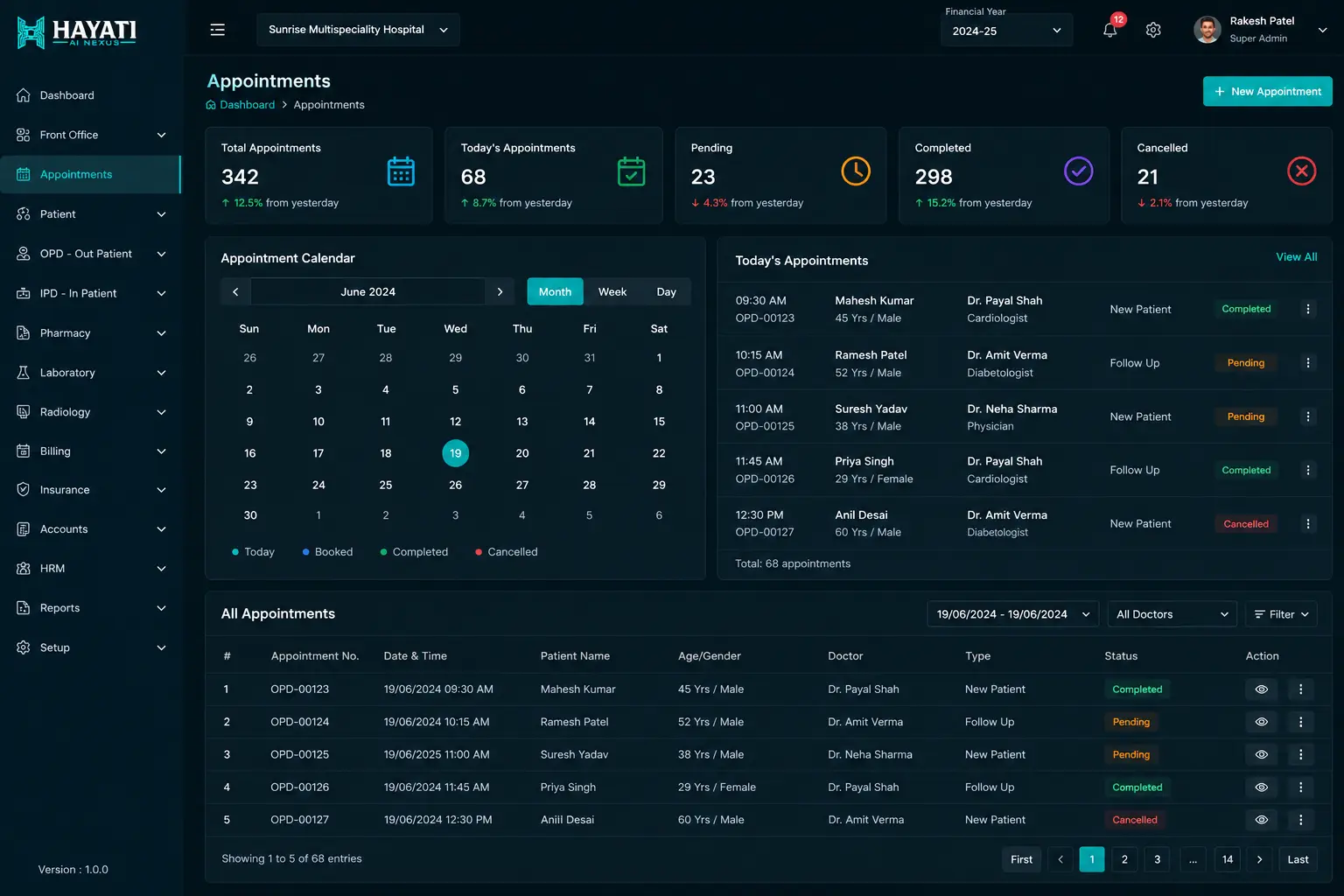
AI Receptionist for healthcare is an inbound call agent that answers hospital and clinic phones, responds in local Indian languages, books or reschedules appointments against your rules, answers common FAQs, and records outcomes for staff review on the Physical Appointment Dashboard. It is not clinical triage—it escalates emergencies and complex cases to humans.
Inbound call
Patient dials hospital main line or branch DID
AI answers
Regional language greeting and intent capture
Slot check
Rules from Physical Appointment Dashboard
Confirm
Verbal + WhatsApp/SMS when integrated
An AI Receptionist is a governed voice agent for hospitals and clinics—not a generic chatbot on a website. It handles high-volume questions: doctor availability, OPD timings, directions, and appointment booking while your human reception team focuses on walk-ins, insurance paperwork, and exceptions. Hayati scopes language packs, escalation paths, and CRM handoff during onboarding so procurement teams know exactly what is automated versus what stays with staff.
Indian patients expect regional tone, not robotic English-only IVR trees. Hayati AI Receptionist supports Hindi, English, Telugu, Tamil, Marathi, Gujarati, and additional packs depending on deployment. Accent and phrasing are tuned per region during pilot—not promised as unlimited languages on day one. Confirm supported packs on your walkthrough with real call recordings from your city.
Patients trust reception that sounds local. The agent uses conversational pacing, polite honorifics where appropriate, and hospital-specific vocabulary you approve in script review. Scripts cover appointment types, department names, and parking directions without inventing clinical advice. Marketing pages do not publish fake demo calls—your pilot uses your real hospital name and timings.
When a caller asks for an appointment, the agent checks doctor and department rules you configure—OPD slots, follow-up windows, and blocked holidays. Successful bookings write to the Physical Appointment Dashboard so reception sees AI-booked visits beside walk-ins and portal requests. CRM integration depth depends on your contract: at minimum, intent and contact capture; at maximum, patient match on mobile number with deduplication rules.
Verbal confirmation is not enough for Indian patients who expect WhatsApp proof. Where messaging is integrated, the AI Receptionist sends appointment details—date, time, doctor, location pin—after booking. Template compliance and DLT registration remain your operational responsibility; Hayati connects the workflow spine, not your telecom approvals.
Reception teams answer the same questions hundreds of times per week: parking, visiting hours, which floor, whether a doctor is on leave. The AI Receptionist answers approved FAQ packs and escalates when the knowledge base does not cover a question. This reduces hold times without pretending the agent knows clinical outcomes or test results.
Hospitals lose appointments when phones ring unanswered at night or during peak OPD when staff are checking in patients. Governed 24/7 coverage captures intent and books against next-day rules where configured. After-hours bookings appear on the Physical Appointment Dashboard for morning confirmation—your policy decides auto-confirm versus staff review.
Emergency symptoms, angry callers, insurance disputes, and VIP requests should reach humans. Hayati designs warm-transfer or callback queues rather than forcing AI to complete every call. Audit logs show what the agent captured before handoff so staff do not re-ask every question.
Human reception excels at judgment, empathy for distressed callers, and physical check-in. AI reception excels at never missing a ring, consistent FAQ answers, and instant slot checks at 2 AM. Mature deployments blend both: AI handles volume and after-hours; humans handle exceptions. Hayati does not publish unverified cost-savings percentages—measure handle time and missed-call rate in your pilot branch.
Multi-specialty hospitals route calls by department keyword. Polyclinics often start with one OPD line and one language pack. Pharmacy chains with clinic counters may use AI only for appointment lines, not wholesale order desks. Rollout is branch-by-branch with script sign-off from medical administration where required.
Pricing depends on call volume, language packs, messaging integrations, and number of DIDs. Setup includes script workshop, escalation matrix, dashboard field mapping, and parallel run where staff compare AI bookings to manual registers for two weeks. No fake ROI figures appear on this marketing page—outcomes are measured in your environment.
After the call, operations continue on GST billing, FEFO inventory, TPA workstations, offline counters, and operational reports on the same Healthcare Operating System spine. AI Receptionist reduces missed intake—it does not replace the billing, pharmacy, or accounts floor your team already runs.
Inbound call hits your configured DID or main line routed to the AI Receptionist.
The agent greets in the approved regional language and identifies intent—appointment, FAQ, or escalation.
Caller states department, doctor preference, or asks timing and location questions from the approved FAQ pack.
Availability rules pull from the Physical Appointment Dashboard—blocked slots and holidays respected.
Selected slot is held per your policy; patient hears date, time, and doctor name repeated for confirmation.
When messaging is integrated, confirmation includes location and arrival instructions using approved templates.
Booking record appears on the Physical Appointment Dashboard with source tagged as AI Receptionist for staff review.
Staff confirm or adjust bookings, check in walk-ins, and handle escalations the agent transferred overnight.
Hindi, English, Telugu, Tamil, Marathi, Gujarati, and additional packs per deployment. Confirm supported tones and scripts on walkthrough—not all languages on day one for every site.
No. It reduces missed calls and repetitive FAQ load. Humans handle walk-ins, insurance exceptions, emergencies, and complex scheduling.
Yes, against rules you configure. Many hospitals require morning staff confirmation; others auto-confirm low-risk OPD slots.
Bookings write to the same dashboard reception uses for walk-ins and phone bookings, with source metadata for audit.
Supported when messaging integration and templates are approved in your environment. Hayati wires the workflow; template compliance is operational.
Call capture and intent can be recorded locally and synced when connectivity returns at sites with intermittent links—scope per deployment.
Scripts exclude diagnosis and treatment guidance. Emergency keywords trigger immediate human escalation paths configured in onboarding.
Typically two to four weeks for script workshop, pilot DID, parallel run, and sign-off—depends on departments and language packs.
Hayati focuses on your operational spine. Third-party portal integrations are scoped case-by-case during discovery.
Missed-call rate, booking conversion, escalation rate, and staff time spent correcting AI bookings—use your branch baseline, not marketing benchmarks.
All features: AI Receptionist · AI Retention Agent · Patient Queue Display · Doctor Dashboard · TPA billing · Multi-branch · Pharmacy inventory · GST billing · Offline billing · Queue management
Book a walkthrough with your real call scenarios, languages, and appointment rules.